Magnetic Resonance Imaging
Introduction
In 1952, Bloch and Purcell won the Nobel Prize in Physics for the development of the analytical technique known as nuclear magnetic resonance (NMR). Magnetic resonance imaging (MRI) is an adaptation of NMR for medical diagnostic purposes.
Both NMR and MRI rely on the fact that some atomic nuclei have a magnetic moment associated with their spinning. The most common nuclei studied using NMR are H-1, C-13, F-19 and P-31. Most MRI studies involve the H-1 nuclei in water.
The isotopes listed above have two spin states. When these nuclei are exposed to an external magnetic field, their spins can be parallel or anti-parallel to this external field. Transitions between these two spin states can be induced with energy from radio waves of the proper frequency. A radio frequency (rf) signal is transmitted to the sample, which has been placed in a strong magnetic field. The nuclei of atoms in the sample interact with the rf signal. An rf receiver measures the signal after its interaction with the sample. The analysis of these measurements can help to identify the structure of the sample.
MRI instruments are massive pieces of equipment. Some representative specifications from an instrument manufacturer are collected in the table below.
Bruker Full-size whole-body MRI/MRS system | |||
| MEDSPEC 30/80 | MEDSPEC 30/100 | MEDSPEC 40/80 | |
| Magnet-field strength | 3 Tesla | 3 Tesla | 4 Tesla |
| Bore, diameter of patient instrument cavity | 80cm | 94 cm | 80 cm |
| Max. gradient strength | 45 mT/m | 30 mT/m | 45 mT/m |
| Magnet weight | 7.8 tons | 12 tons | 13 tons |
| Body region to be examined | brain, extremities, cardiac, and spine | whole-body | brain, extremities, cardiac, and spine |
Other NMR/MRI web sites
National Magnetic Resonance Facility at Madison
Magnetic Resonance Imaging (MRI) – Body
Magnetic resonance imaging – Wikipedia, the free encyclopedia
How Stuff Works: Magnetic Resonance Imaging (MRI)
Suppliers of MRI Equipment
General Electric Healthcare
For the latest in MRI diagnostic equipment
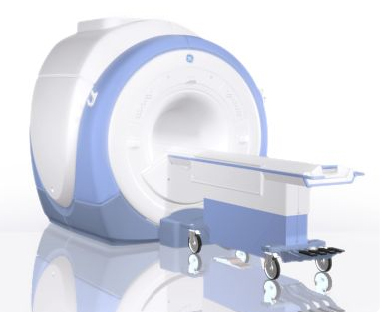
http://www.gehealthcare.com/usen/mr/signahdx_30t/index.html
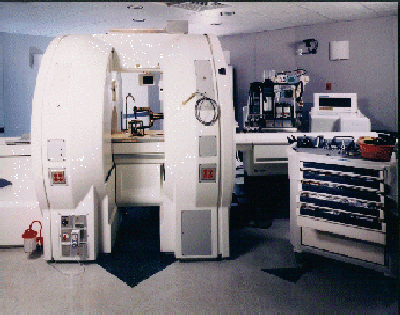
This MRI unit is used in the operating room during surgery. For more information, see: http://www.gehealthcare.com/usen/mr/products/mrsurgical_suite.html
Bruker
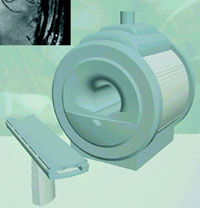
Instruments and Devices Pages
Background
-
Atomic Force Microscopy
-
NMR/MRI Movies
-
Probe Microscopes
-
Atomic Imaging
-
Scanning Tunneling Microscope: Individual Atom Manipulation
-
Structure of DNA